This article contains affiliate links. We may earn a small commission if you purchase through an eBay link — at no extra cost to you.
Counterfeit Pokémon cards have been a problem since at least the early 2000s, but the quality of fakes in 2026 is genuinely alarming. Where earlier counterfeits were easy to spot from across the room — wrong colors, blurry fonts, obviously wrong card backs — modern fakes are printed on higher-quality stock, use better inks, and sometimes even replicate the holofoil pattern convincingly enough to fool casual buyers.
If you're buying raw cards from eBay lots, dollar stores, flea markets, or Amazon third-party sellers, you need to know what to look for. This guide covers every detection method that actually works.
Why Fakes Have Gotten So Much Better
The Pokémon card market's explosion in value — driven by the 2020–2021 pandemic boom and celebrity attention — made counterfeiting enormously profitable. When a Base Set Charizard is worth thousands of dollars, organized counterfeiters can invest in high-quality printing equipment and still make substantial margins.
Industrial printing technology has also democratized. Print-on-demand equipment capable of producing convincing card-quality prints has become cheaper and more accessible. Counterfeiters operating out of parts of Asia and Eastern Europe now produce fakes that require careful inspection to catch.
The Cards Most Targeted by Counterfeiters
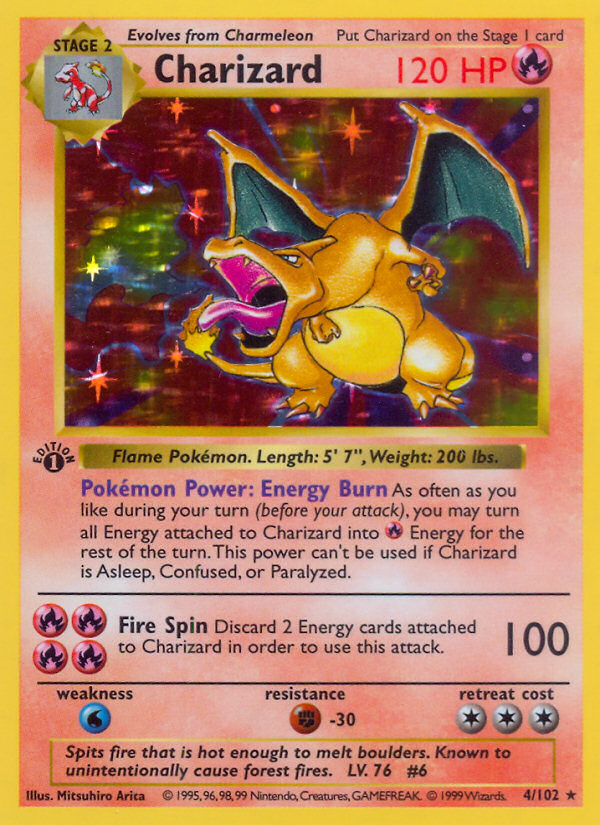
Charizard — Base Set 1st Edition
Base Set 1999
~$500–$400,000+ depending on grade
The most counterfeited Pokémon card in existence. 1st Edition Base Set Charizard, Shadowless Charizard, and Unlimited Charizard are all faked. The 1st Edition stamp is particularly targeted because it adds significant value and is a small, reproducible detail. Never buy a raw 1st Edition Charizard for significant money without extensive authentication.
The rarest legitimate Pokémon card ever made. Because only 39 authentic copies are known to exist, virtually any raw copy offered for sale at any price is a fake. Authentic Pikachu Illustrators are almost exclusively found in PSA slabs with verified certification numbers. If someone is offering you a "raw" Pikachu Illustrator, it is a fake.
Black Star Promos — Early Set
Wizards of the Coast Promos 1998–2003
~$20–$5,000 depending on card
Early Wizards of the Coast Black Star Promos (Pikachu, Mewtwo, Ancient Mew, No. 1/2/3 Trainer) are heavily counterfeited. The No. 1 and No. 2 Trainer promos in particular — distributed only to winners of official Pokémon tournaments in Japan — are worth tens of thousands of dollars and are almost impossible to authenticate without professional grading.
The Light Test
The easiest first-pass test is holding the card up to a bright light source — a lamp, phone flashlight, or sunlit window — and looking at the holo pattern through the card from the back.
On a legitimate Pokémon holo card, you should be able to see the holographic shimmer pattern from the reverse side of the card when light passes through it. This happens because the genuine holofoil layer is thin enough that light transmits through, creating a distinctive glimmer visible through the card back.
Most counterfeit holofoil doesn't transmit light in the same way. Fakes typically appear more opaque when backlit, or show an inconsistent, flat shimmer rather than the sparkly, multi-directional holo pattern of genuine cards. This test is not 100% definitive — some fakes have improved — but it catches a large percentage of counterfeits quickly.
Font and Text Analysis
Pokémon cards use a proprietary font for card text that counterfeiters frequently get wrong. The Pokémon TCG font has specific characteristics:
- The letter "a": In genuine Pokémon card text, the lowercase "a" has a distinctive double-story shape (like a printed "a" rather than a handwritten one). Many fakes use incorrect font variants where the "a" looks different.
- HP numbers: The HP font on genuine cards uses a specific weight and style. Fakes often show slightly different number shapes, particularly in the rounded numerals like "8" and "9".
- Damage numbers: Fake cards frequently show damage values in slightly wrong fonts or at incorrect sizes. Compare damage text carefully against a verified authentic copy.
- Copyright text: The small copyright line at the bottom of genuine cards follows specific formatting. Fakes often truncate it, misspell words, or use the wrong size text.
Card Weight and Thickness
Genuine Pokémon cards have very consistent weight and thickness, defined by the printing process Pokémon uses with its official printers. Counterfeit cards are typically printed on different card stock and fall outside these tolerances.
A kitchen scale accurate to 0.01 grams is a useful tool for collectors. Genuine Pokémon cards typically weigh between 1.7 and 1.8 grams. Cards that read significantly lighter (some fakes on thinner stock) or heavier (some fakes that add laminate layers) warrant further scrutiny.
Thickness can be tested with calipers. Genuine cards measure approximately 0.35mm. This test is more definitive than weight for cards where counterfeiters have matched the weight but used laminated stock.
The Rosette Pattern Test
Professional commercial printing — including genuine Pokémon cards — uses an offset lithography process that creates a microscopic "rosette" pattern visible under magnification. If you hold a genuine Pokémon card under a jeweler's loupe or macro lens at 10x magnification, you'll see the ink is made up of tiny dots arranged in a circular rosette pattern. This is standard for all offset-printed products.
Most counterfeit cards are printed on inkjet or laser printers. These use different dot patterns — inkjet shows irregular scattered dots, laser shows a different grid pattern. Under a loupe, a fake will look distinctly different from a genuine card.
A 10x jeweler's loupe costs under $15 and is one of the best investments a serious collector can make for authentication purposes.
Color Saturation and the Card Back
Genuine Pokémon card backs have a specific, consistent shade of blue that has been standardized since the early sets. This shade is notoriously difficult to replicate exactly, and many counterfeit backs read as slightly wrong — either too vivid, too dull, too green-shifted, or too purple-shifted.
Compare a suspicious card's back directly against a verified genuine card you already own. Place them side by side and look at the blue background. Any obvious color difference is a strong red flag.
Color saturation issues also affect the front art. Genuine cards have calibrated ink density. Counterfeits often show colors that are either more washed out or more aggressively saturated than genuine cards. This is particularly visible in the yellow of Pokémon card borders — genuine cards have a specific yellow that fakes rarely match perfectly.
Set Symbols and Stamp Placement
Each Pokémon set has a unique set symbol that appears in a specific location on the card (typically lower right of the art box). On genuine cards, this symbol is printed at a precise size with clean, sharp edges. Counterfeit set symbols are often:
- Slightly the wrong size — either too large or too small
- Placed at a slightly wrong position relative to the card border
- Lacking the crisp detail of the original, especially on complex symbols with fine lines
- Showing "bleeding" where the ink hasn't held its edges cleanly
The 1st Edition stamp — the small oval stamp that appears below the card art on 1st Edition prints — is particularly scrutinized. The stamp should have clean, raised-looking ink at normal viewing distance. Counterfeit stamps often look flat, slightly fuzzy, or are positioned at wrong coordinates on the card face.
Energy Symbols
The energy type symbols (Fire, Water, Grass, etc.) that appear in attack costs and on Energy cards are printed at specific sizes with specific proportions. Counterfeit cards often show energy symbols that are slightly misshapen — the flames on Fire energy are a common tell, as are the lightning bolts on Lightning energy.
Compare energy symbols under a loupe if you have any doubt. The symbol shapes are distinctive enough that any deviation from the genuine design is visible under magnification.
Where Fakes Show Up Most
Understanding where counterfeit cards are most commonly sold helps you calibrate your risk:
- eBay bulk lots: "Job lots," "mystery lots," and large collections sold by weight or by lot are the highest-risk category. Individual sellers often claim to not know if cards are fake — but bulk lots that seem too good to be priced are often packed with counterfeits.
- Dollar stores and discount retailers: Counterfeit packs and individual cards are regularly found at discount retailers in packaging designed to look like genuine Pokémon product. Never buy Pokémon packs from a non-authorized retailer.
- Amazon third-party sellers: Amazon does not authenticate TCG cards. Third-party sellers on Amazon, particularly those shipping from overseas, have been caught selling counterfeit cards repeatedly. Stick to Amazon directly-fulfilled products or authorized retailers.
- Flea markets and swap meets: The classic venue for counterfeit TCG cards. Cards sold loose at flea markets have essentially no provenance and a high counterfeit rate for valuable singles.
- Social media direct sales: Instagram and Facebook Marketplace sales for high-value vintage cards carry significant risk without extensive due diligence.
What to Do If You Think You Have a Fake
If a card fails any of the tests above, don't panic — but do stop trying to resell it as genuine. Knowingly selling counterfeit cards is fraud. Your options:
- Contact the seller where you bought it and request a refund (eBay's buyer protection covers counterfeits explicitly)
- Submit the card to PSA or CGC — they will return it ungraded if it's a fake, but the authentication opinion from a major grader is definitive
- Take it to a local game store — experienced TCG staff can often identify obvious fakes immediately
When in doubt, buy graded. A PSA, BGS, or CGC slab comes with the grading company's authentication guarantee. For any card worth more than $200, the premium for a slabbed copy is cheap insurance against counterfeits.
Verify cards on Hardcore Collectors →Related Articles
Share this article
Track Every Card Mentioned in This Article
Add cards to your collection, watch market prices move in real-time, and connect with other collectors.
Create Free Account →